This blog is my own personal time travel into the past...

Saturday, 22 September 2012

THE GARDENS OF BABYLON

For my third History Club presentation, I wanted to talk about the Gardens of Babylon and the machines they must have used to water all the plants.
First I did a drawing based on one of the pictures I saw on Google, then mum helped me pull out all the styrofoam we had collected and helped me cut it so it looked like a terraced construction. Then we got some plastic flowers and plants to stick into the soft styrofoam and decorated our gardens. It looked pretty cool.
 
4
We were going to put steps leading up to each terrace but it looked better without them.
Then we found out how they must have watered these gardens using machines like the Archimedes screw, chain pumps, aqueducts, shadufs and water wheels as they carried the water from the Euphrates river to the gardens. There wasn't very sophisticated machinery in the 6th century BC and they had a long way to haul the water, so nobody really knows how they did it and if the gardens really existed at all.
 I made my own Archidemes screw from a pipe and some hose. Then I covered it in sand to make it look more primitive, then covered it in varnish to make it waterproof.
 It worked really well!
 
 I also made a chain pump with recycled materials.
 That also worked really well after a few adjustments.
 I had to put plastic tongues on the edge of the "buckets" so the water could fall without dribbling.
 Then a simple water wheel that didn't work very well because it was a bit stiff.
And an aqueduct which would have been important for carrying the water from the river to the gardens.

Saturday, 11 August 2012

A MÉRIDA LAPBOOK

 After our trip to Mérida, I made a lapbook of all the things I remembered learning and used the photos that I took while I was there. I made the lapbook from book packaging cardboard and my mum helped me with the stone drawings inside the lapbook.

Sunday, 5 August 2012

MÉRIDA

 Mérida was called Emerita Augusta when it was founded in 25 BC because of the emperor Augustus and because it was created as a place for retired soldiers as "merit" for their service.
I loved seeing all the Roman stuff that I'd only ever seen in books. Next to the old monuments there were pictures to show you how it would have looked in Roman times.
These photos are of the Temple of Diana and the Roman bridge over the river Guadiana.
 This is the walls of the Alcazaba (Moorish Citadel) completed in 838AD and is the only Muslim building left in Mérida.
The other photo is of the Arch of Trajan. It was built in granite and covered in marble.
 This was the Forum which is like a main square. There are copies of the Corinthian columns and statues.
The below photo gives a better idea of what it looked like in Roman times.
 This is the circus where they had chariot races.
 This is the theatre and an underground passage.
 These are also Corinthian columns and capitals but the statues are copies. The originals are in the museum.
 A peristyle and the amphiteatre where gladiators fought against each other and against wild animals.
 Then we went to the National Museum of Roman Art which is a really cool museum with millions of things to see, like glass, weapons, coins, mosaics, statues, tools, jewellery, pottery, etc, etc.
 
On the way out of the city we stopped to look at one of the aqueducts that are standing.

Tuesday, 31 July 2012

A ROMAN ARCH

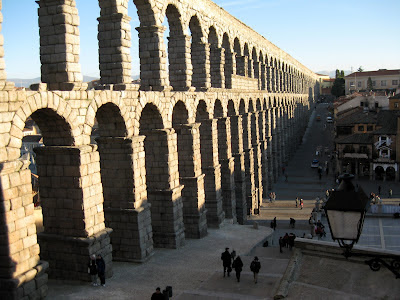
 I experimented with some Roman constructions like the arch to see how they made them with stones. I used plasticine which also worked because the shape is what keeps it all together. The keystone (the one at the top in the middle) is the most important stone. You can see a lot of arches and keystones in  aqueduct in Segovia.