This blog is my own personal time travel into the past...

Saturday, 21 July 2012

A ROMAN VILLA AND THE MAGNA MATER

 There is a new museum in Las Cuevas de Soria of an authentic Roman villa fom the IV century AD.
It was discovered and excavated between 1927 and 1928 and used to belong to a Hispano Romano family of Celtiberian origin.
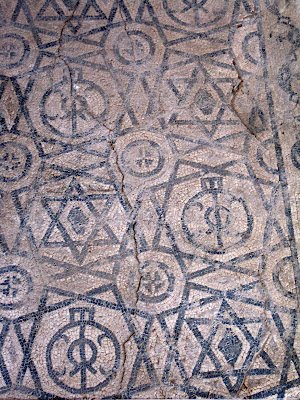
Now you can see how it had a central garden patio and 30 rooms decorated with mosaics. There were baths and lots of mosaic floors. The mosaics were made from local limestone and mostly in geometrical designs. A person who made these mosaics was called a Musivario.
Also in this museum there is a part that talks about the Earth Goddesses throughout history and especially the Magna Mater who was known as the goddess Cibeles. (There is a statue of her in Madrid!)
We were in the first group to have a tour of this new museum. 
 The above photo is of the baths and below is a collection of different mosaic floors.
 Here you can see the monogram of the family name - Irrico  It is like a symbol that puts all the letters of the name together. You have to look carefully but you can see it in the bottom left symbol in the above photo.
These stones show the kinds of limestone they used to make the mosaics.

Sunday, 8 July 2012

A MEDIEVAL FIESTA

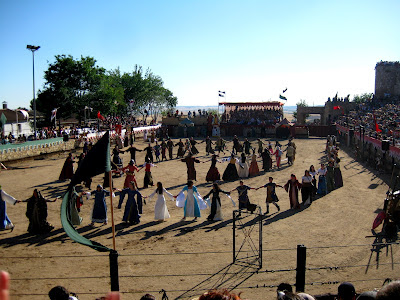
 We went to a historic town called Hita in Guadalajara which is about 85km from Madrid. They have a medieval fiesta there every first weekend in July.
It was really cool beause you got to see how the soldiers really looked and jousting on horseback, etc. I got to try a bow and arrow and I bought myself a diabolo.
 

Tuesday, 19 June 2012

GATEWAY OF DEATH

When I went on a bike ride with my mum to Casa de Campo in Madrid, we came across a sign that said Pasarela de la Muerte (Gateway of Death). It said that there used to be a bridge here that was built at the end of the Spanish Civil War by the Francoists who were winning the war.
It was called that because the river Manzanares was guarded by the Republicans who said "They Shall Not Pass", meaning Franco's forces with the Morrocan, Italian and German allies of Franco and their tanks.
There was a three year seige in Madrid and many bridges were built over the river. But they were very dangerous to cross and were called the gateway of death because they were always in a direct line of fire.
Then the Francoists began building a cement one at the end of the war that you can still see a bit of today, (the top bit) which I think is really interesting. It was called the Generalisimo Bridge - as in VERY General Bridge!
 This is the top part of the bridge that you can still see.
In the below photo you can see what it used to look like and at the end of the bridge you can see the bit that's still there.

Tuesday, 29 May 2012

THE STORY OF THE WORLD AND A SHADUF

 
 I am a member of a history club and we are all reading STORY OF THE WORLD by Susan Wise Bauer. We read a few chapters and present to the group a part of the book.
My first presentation was about the first farmers and how they used the shaduf.
First I made a simple one to see how it worked.  
 Then I made another one from sticks and a leather bucket.
For the presentation I was an archaelogist explaining to a group how the shaduf worked by dipping the bucket into a river and using the stone as a weight, they swung the beam around to water the crops. I think it's a really cool machine.
 

Thursday, 3 May 2012

A MUSEUM AND A CELTIBERIAN VILLAGE

In Soria, we went to a museum in Garray where there is a lot of local Celtiberian and Roman history.
In this photo you can see a battering ram they used to knock down fortress doors. 
This is a Roman military camp.
 
These figures are cute. 
 Then we went to Numancia where there is a village of Celtiberian origins. The Celtiberians fought against the Romans for 20 years before the Romans finally took the village. Then they built their own houses on top of the other one.
 This is a circular rainwater cistern for public use.
 These are hand querns used for milling the grain. They made beer from fermented wheat.
 This one is a Roman house. It has a roof of rye sheaves.
 These are looms for weaving cloth.
 These photos are of a Celtiberian house with a Celtic symbol on the door and the kitchen.

Friday, 20 April 2012

VIKINGS

This is a lapbook about Vikings. I did all the research myself and found pictures on the Internet.
I love the way they eat their chicken!
 

Friday, 13 April 2012

TITANIC

I did a project on the TITANIC because I am a fan and it was its 100th anniversary. It is a very cool boat. I used an old picture book with holes to make it look like the portholes on a boat.